
The $827 Billion Shift: Why AI Is Rewriting the Rules of Search
AI Overviews reach 2B users and cut organic CTR by 61%. Here's what the $827B AI market shift means for SEO and how to adapt your strategy.

Google's AI Overviews now reach 2 billion monthly users across 200+ countries [1]. Where they appear, organic click-through rates collapse by 61% [2]. These aren't incremental changes. They're structural shifts in how people find, evaluate, and act on information online.
The global AI market is on track to hit $826.73 billion by 2030 [3], and search is ground zero for that investment. What does this mean for businesses that depend on organic traffic? And what should you actually do about it?
Key Takeaways
- AI Overviews trigger on 48% of tracked queries, reducing organic CTR by up to 61% [2]
- Google plans $175-185B in AI infrastructure spending for 2026, doubling year-over-year
- Brands cited in AI Overviews earn 35% more organic clicks, making citation the new ranking signal
- AI search traffic converts at 5x the rate of traditional organic, shifting the equation from volume to quality
How Big Is the AI Search Shift, Really?
The global AI market will grow from $243.72 billion in 2025 to $826.73 billion by 2030, a compound annual growth rate of 27.67% [3]. But the raw market figure obscures where the money is actually flowing. Google alone tells the story.
Alphabet's annual revenue crossed $400 billion for the first time in 2025 [4]. Search revenue grew 17% in Q4. The company isn't retreating from search. It's rebuilding it from the ground up.
Here's what makes the financial picture striking. Alphabet's AI capital expenditure jumped from $32 billion in 2023 to $91.4 billion in 2025. For 2026, the company plans to spend $175 to $185 billion on AI infrastructure [5]. That's roughly 45% of annual revenue committed to AI buildout.
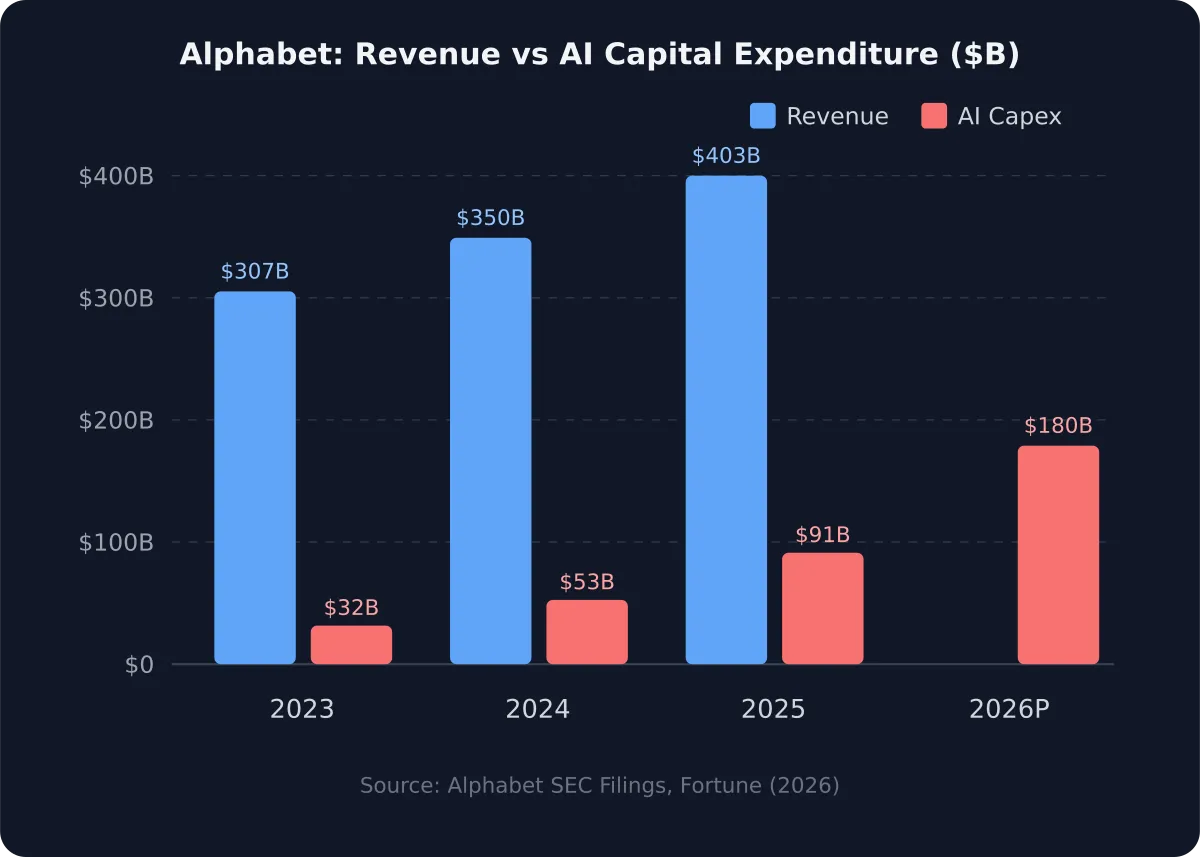
Worth noting: Google is spending on AI at a rate that dwarfs its search advertising revenue growth. This isn't a company hedging its bets. It's a company restructuring its core product around a fundamentally different interaction model. When the world's largest search company commits roughly half its revenue to changing how search works, the downstream effects on every business relying on organic traffic aren't theoretical. They're already measurable.
Why does this matter for your SEO strategy? Because the $827 billion AI market trajectory runs directly through the search results page. Every dollar of that investment changes what your audience sees when they type a query.
What Happens to Clicks When AI Answers the Question?
Organic CTR dropped 61% for queries where AI Overviews appeared, falling from 1.76% to 0.61%, according to a study of 25.1 million impressions across 42 organisations [2]. This isn't an isolated finding. Three independent studies using different methodologies arrive at the same conclusion.
Ahrefs analysed 300,000 keywords and found AI Overviews reduced clicks to the top-ranking page by 58% [6]. Pew Research Center tracked 68,879 unique Google searches from 900 U.S. adults and found users clicked results just 8% of the time with AI summaries versus 15% without, a 47% relative reduction [7].
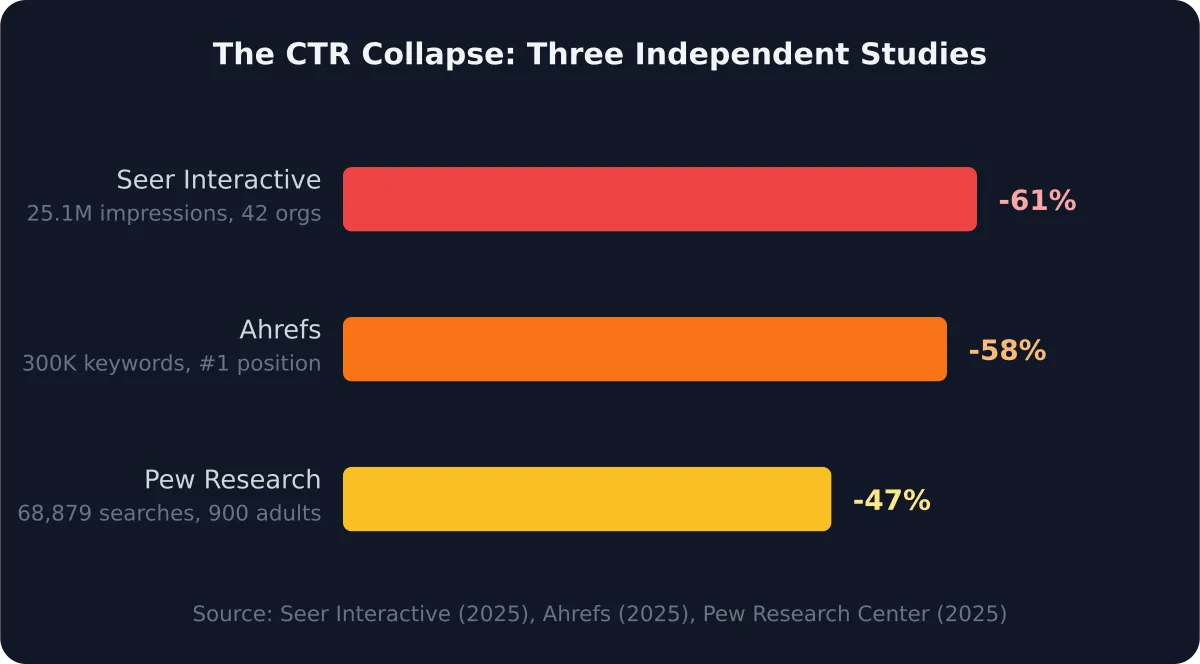
Three different research teams. Three different sample sizes and methods. One consistent finding: AI Overviews absorb roughly half to two-thirds of clicks that would otherwise go to organic results. Can you afford to build your growth strategy on a channel losing this much ground?
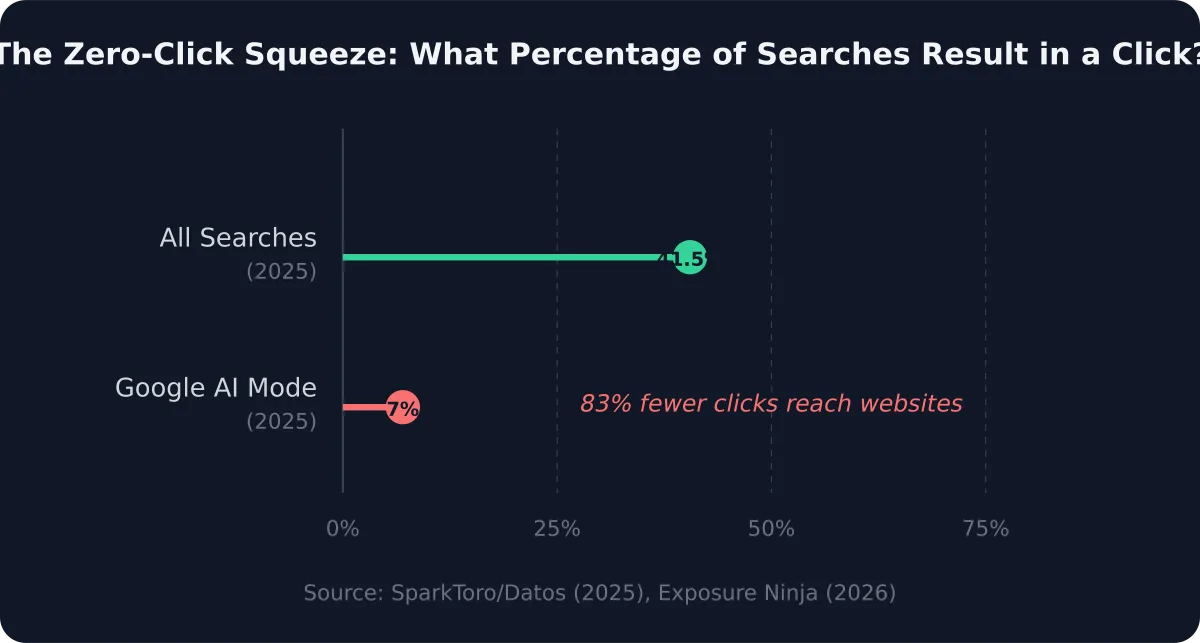
The zero-click picture deepens the concern. 58.5% of all Google searches in the U.S. already end without a click to any website [8]. In Google's experimental AI Mode, that figure climbs to 93%.
The convergence of evidence from Seer Interactive, Ahrefs, and Pew Research across dramatically different methodologies, from clickstream panels to controlled search experiments, suggests the CTR impact is structural rather than anomalous. This isn't a temporary dip. It's the new baseline.
Why Does AI Search Traffic Convert 5x Better Than Organic?
Early data suggests AI search traffic converts at 14.2% compared to Google organic's 2.8%, with Claude-referred traffic converting at 16.8% [9]. The volume story looks bleak. The value story tells something entirely different.
Think about what happens when someone gets an AI-synthesised answer and still clicks through to your site. They've already read the summary. They've already evaluated whether you're worth their time. That's a fundamentally different visitor than someone scanning ten blue links and picking the third one.
The citation data makes this actionable. Brands cited in AI Overviews earn 35% more organic clicks and 91% more paid clicks compared to non-cited brands [2]. Being referenced by AI isn't just a visibility play. It's a direct conversion driver.
The counterintuitive finding: Fewer total clicks doesn't necessarily mean less business value. If AI search sends you 40% fewer visitors but those visitors convert at 5x the rate, the net outcome can be positive. The businesses panicking about traffic drops may be measuring the wrong metric entirely.
So what does "being cited" actually require? It means your content needs to answer specific questions concisely enough for AI systems to extract and attribute. Structured content. Named sources. Evidence-backed claims. Not keyword-stuffed pages built for crawler consumption, but authoritative writing built for extraction.
Are Businesses Actually Adapting to AI Search?
94% of marketers plan to use AI in content creation in 2026, and 92% are already optimising for AI-powered search engines [10]. The awareness is clearly there. Whether the execution matches is another question entirely.
On the consumer side, 37% of AI tool users now start searches with AI platforms instead of traditional search engines [11]. That figure likely overstates general population behaviour, since the study surveyed active AI users specifically. But the directional trend is unmistakable, and it's accelerating.
Gartner predicted search engine volume would drop 25% by 2026 due to AI chatbots [12]. A subsequent Gartner forecast projects organic search traffic will fall 50% by 2028, according to research cited by industry analysts including Seer Interactive's Wil Reynolds.
What we're seeing: Most businesses haven't fundamentally changed their SEO approach. They've added AI writing tools to their existing workflow. But bolting a chatbot onto an Ahrefs subscription isn't the same as rethinking your entire search strategy for a citation-first world. The tools haven't caught up to the problem.
Here's the paradox worth sitting with. The SEO services market is actually growing, valued at $83.9 billion in 2026 and projected to reach $148.86 billion by 2031 [13]. More money flowing into SEO, even as traditional SEO tactics lose effectiveness. What's filling the gap? AI-native approaches to content strategy, competitor analysis, and search optimisation that treat citation as a first-class metric.
AI Overviews now trigger on 48% of all tracked queries, up 58% from roughly 31% one year earlier [14]. The window for "wait and see" is closing fast.
What Three Shifts Will Define the Next 18 Months?
Gartner projects organic search traffic will decline 50% by 2028, according to research widely cited by industry figures including Wil Reynolds of Seer Interactive. If even half that prediction materialises, the businesses adapting now will hold a compounding advantage over those that waited.
Citation Is the New Ranking Signal
Traditional SEO measured success by position. Page one, position three, featured snippet. AI search introduces a new layer: citation. When an AI system synthesises an answer, does it reference your content? Does it link back to your site? Position tracking still matters. But it's no longer sufficient on its own. You need visibility into where your brand appears in AI-generated responses, not just in blue links.
Write Answers, Not Keyword Pages
AI Overviews reward concise, authoritative answers to specific questions. Not pages optimised around keyword density or stuffed with variations of the same phrase. The content that gets cited is structured with clear headings, evidence-backed claims, and direct answers in the opening sentences. Think answer-first paragraphs, not keyword-first copy. What does your top-performing page look like through this lens?
Your SEO Stack Is Too Fragmented
The standard 2024 SEO stack looked something like this: Ahrefs for keywords ($99-449/month), SEMrush for site audits ($129-499/month), ChatGPT for content drafting ($20/month), Google Sheets for tracking. Four subscriptions, zero integration between them. You were the glue holding it all together.
That fragmented approach can't keep pace with AI search. The data that informs your keyword strategy needs to flow directly into competitor analysis, which feeds content strategy, which produces drafted articles. Manually stitching tools together introduces delays, drops context, and misses patterns that connected systems catch automatically. The shift isn't just about better tools. It's about connected intelligence.
Built for exactly this shift, PageRise consolidates SEO data, competitor intelligence, and AI-powered content strategy into one platform with agentic workflows. Instead of exporting from one tool and pasting into another, the system handles the full pipeline, from keyword research to published content. You control how much autonomy the AI has at every step through progressive autonomy controls.
Conclusion
The $827 billion AI market trajectory isn't a forecast you can wait out. Google's 2 billion AI Overview users, the convergent 47-61% CTR collapse across three independent studies, and the 5x conversion advantage for AI-referred traffic all point in one direction: search is being restructured around AI, and the restructuring is already well underway.
The winners won't be businesses that ignore the shift or those that panic about traffic declines. They'll be the ones that adapt their strategy now.
Key actions:
- Audit your content for AI citation readiness with answer-first formatting
- Restructure top-performing pages with sourced statistics and concise, quotable passages
- Consolidate your SEO tools into a platform built for AI search intelligence
- Track citation presence alongside ranking position as a core metric
The data is unambiguous. The question isn't whether AI will rewrite search. It already has. The only question left is whether your strategy reflects that reality.
Sources
- Google/Alphabet, 2025 ↩
- Seer Interactive, 2025 ↩
- Statista, 2025 ↩
- Alphabet SEC Filing, 2026 ↩
- Fortune, 2026 ↩
- Ahrefs, 2025 ↩
- Pew Research Center, 2025 ↩
- SparkToro/Datos, 2025 ↩
- Exposure Ninja, 2026 ↩
- HubSpot, 2026 ↩
- Search Engine Land, 2025 ↩
- Gartner, 2024 ↩
- Mordor Intelligence, 2026 ↩
- BrightEdge, 2026 ↩
Published on by Mike , Founder in AI search SEO strategy AI Overviews zero-click search organic traffic
Share this article:

Mike · Founder
Mike is building PageRise after years of working inside the real-world chaos of websites, ads, CRMs, automations, and lead generation. His focus is simple: help brands and small businesses get clearer strategy, better content decisions, and more useful growth intelligence without drowning in dashboards, jargon, or bloated agency retainers.