The $18,000/year problem: why small businesses are being priced out of SEO
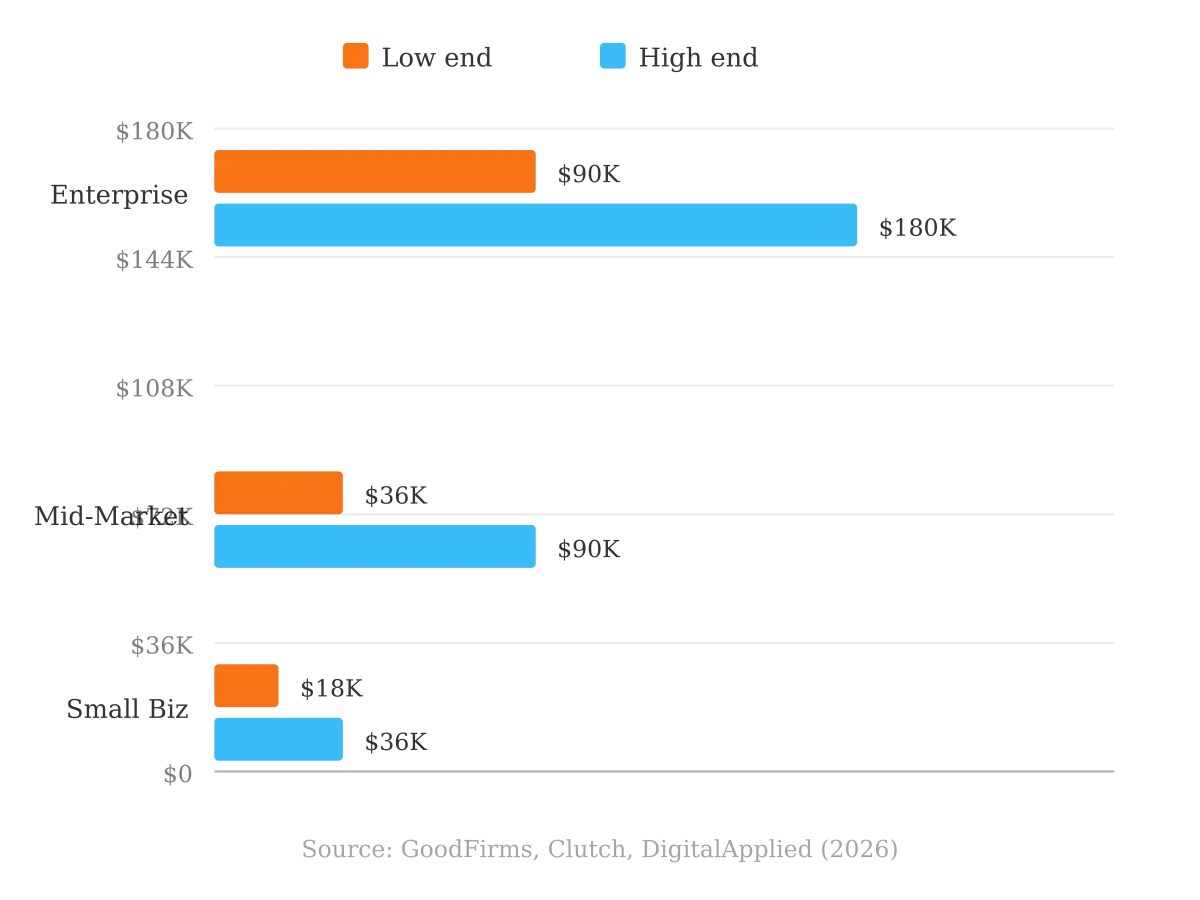
SEO agencies charge $1,500 to $5,000 per month. For a small business making $200K, that is up to 30% of gross revenue on one channel. The economics are broken.
I looked at my accounts last month and did some maths. If I had been paying a typical SEO agency for the work I do myself, it would have cost me between $18,000 and $60,000 this year, based on GoodFirms' 2026 pricing survey of over 300 agencies. That is for a single website. For a small business pulling in $200,000 in revenue, spending $30,000 on SEO means 15% of gross income goes to one marketing channel. Some businesses are paying more.
The question I kept asking was: is this actually worth it? And more importantly, is there a version of SEO that does not require a second mortgage?
Key takeaways
SEO agencies charge $1,500 to $5,000 per month for small businesses, with the average around $3,199 per month (GoodFirms, Clutch, 2026).
At $1,500 per month, you spend $18,000 per year. At $5,000, it is $60,000. That is before ad spend or content production costs.
Meaningful SEO requires 15 to 40 hours of work per month, according to agency survey data [1].
AI tools have reduced the cost of routine SEO work by 20 to 30%, but retainers have not fallen by the same amount [1].
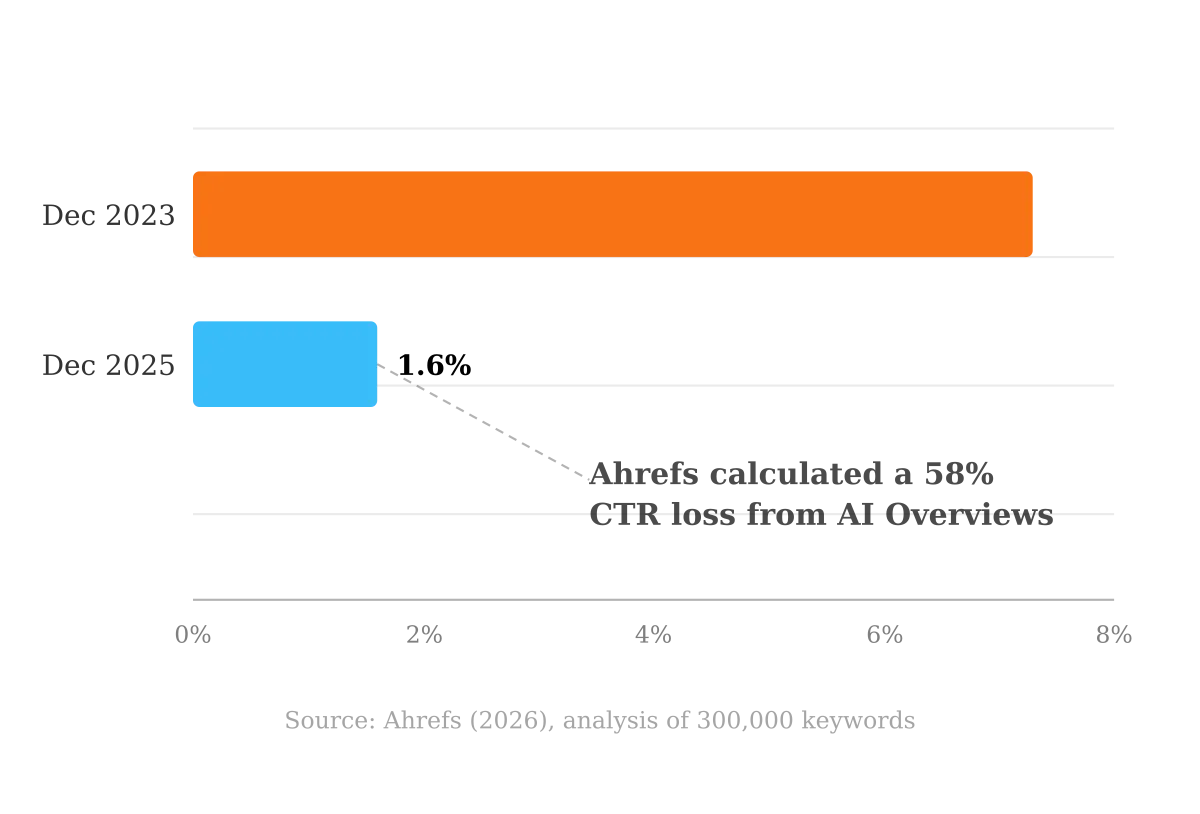
Google AI Overviews are reducing organic click-through rates by up to 58%, meaning you pay more for SEO and get fewer clicks [2].
These numbers describe the middle of the market. Below $500, you are not buying SEO. You are buying a templated report and automated link spam that can get your site penalised. Above $15,000, you are in enterprise territory with dedicated teams and custom strategies.
A typical small business retainer at $2,500 per month buys you about 15 to 20 hours of work. That breaks down into roughly four to six blog posts, on-page optimisation for 10 to 15 pages, basic link outreach (five to 10 links), a monthly technical audit, and a reporting call.
It sounds reasonable until you dig into what those hours actually produce. A lot of agency SEO work is process overhead: exporting data from Ahrefs, reformatting it in Google Sheets, pasting it into a slide deck, and presenting it to you in a monthly call. The strategic work, the part that actually moves rankings, might be four or five hours out of those 20.
I am not saying agencies are a scam. Good agencies do real work. But the pricing model charges you for the entire process, including the parts a machine could do in seconds.
SEO as a percentage of revenue
The numbers get uncomfortable fast. A small business making $100,000 per year and paying $1,500 per month for SEO is spending 18% of gross revenue on one channel. At $2,500 per month, it is 30%. At $5,000 per month, it is 60%.
Even at $200,000 in revenue, $2,500 per month is 15% of gross. That is before you pay for hosting, email marketing, paid ads, social media, or your own salary.
SEO is not the only expensive marketing channel. That matters, because a weak comparison makes the argument easy to dismiss. The fair comparison is SEO against other managed channels, not against a cheap SaaS subscription.
Paid ads can cost more than SEO once you factor in management fees on top of ad spend. GoodFirms puts PPC management at 10-20% of monthly ad spend, with a management floor around $1,500/month. So a small business spending $2,000/month on ads can be paying another $1,500/month just to manage the account. That is $42,000/year before creative production, landing pages, and wasted tests.
Social media is not cheap either when done properly. Content creation, scheduling, community management, reporting, and paid social support run $500 to $5,000 per month for most SMBs. The $15/month Buffer plan is just scheduling. It does not create posts, respond to comments, or turn a quiet account into a channel that generates leads.
Email is cheaper if you only count software. A managed email programme is different. GoodFirms puts email marketing at $300 to $2,000 per month once platform and service costs are included. It is still usually cheaper than SEO, but it only works if you already have a list worth emailing.
SEO is not uniquely expensive. The bigger problem is the long payback period and the lack of invoice transparency. When costs rise across the economy, SEO is often the first to go because the bill is big enough to show up in the P&L and the results are hard to attribute. A $2,500 monthly retainer gets noticed.
Can a freelancer do the same work for less?
Freelancers typically charge $300 to $1,500 per month for small business SEO. That is cheaper, but the quality varies enormously. A good freelancer who knows your industry can outperform a mid-tier agency. A bad one can set you back six months with recycled content and toxic backlinks.
The problem with freelancers is consistency. They get sick, they take on too many clients, they disappear. I have spoken to business owners who went through three freelancers in a year, each one undoing the previous one's work. They lost money, time, and momentum.
If you go the freelancer route, ask for case studies from businesses your size, not enterprise clients. And check their backlink profile on their own site. If they rank for "affordable SEO services," that tells you something. If they do not rank at all, that tells you something else.
How many hours per week does DIY SEO take?
Doing SEO yourself is free in money but expensive in time. DigitalApplied's 2026 pricing analysis says meaningful SEO requires 15 to 40 hours per month, depending on scope. That includes keyword research, content writing, technical fixes, link outreach, and reporting.
With AI tools, the routine part drops. The same DigitalApplied analysis found that AI-assisted workflows reduced the cost of routine SEO tasks by 20 to 30%. It also says work that previously consumed 15 to 20 hours per month can now take 5 to 8 hours with AI assistance.
But there is a catch. Those AI tools still need someone who knows what to ask. You can use ChatGPT to write a blog post, but if you do not know what keywords to target, what search intent looks like, or how to structure content for rankings, you are generating words without strategy. Free tools plus no expertise equals wasted time.
There is also the technical side. Most business owners did not sign up to crawl their own site for broken redirects, fix schema markup, or debug Core Web Vitals. These are the unglamorous tasks that agencies bundle into their retainer. They are also the tasks that, if left undone, quietly cap your rankings no matter how good your content is. A plumber can write great content about boiler repairs. That same plumber probably does not want to learn what a canonical tag is or why their page speed score keeps dropping.
Why is the SEO pricing model broken?
The pricing model is broken because you pay for process, not results. Most agency contracts do not tie fees to traffic growth, ranking improvements, or revenue. You pay $2,500 per month regardless of whether your traffic goes up, down, or sideways.
Agencies justify this by pointing to the 6 to 12 month timeline for SEO results. That timeline is real. But it also means you spend $15,000 to $30,000 before you know if the work is paying off. If it does not, you start over with a new agency and another six month commitment.
Meanwhile, the cost of the underlying work has dropped. AI tools have made keyword research, content briefs, technical audits, and reporting cheaper to produce. Agencies that have adopted AI workflows pass some savings to clients, but strategic and creative work still commands premium pricing. The tasks that got cheaper are the ones you were already overpaying for.
If the cost was the only problem, this would be a pricing complaint. But there is a second issue. Google AI Overviews are eating organic traffic.
Ahrefs analysed 300,000 keywords and found that AI Overviews reduce clicks to top-ranking content by 58%. For keywords that triggered an AI Overview in December 2025, the average position one CTR fell from 7.3% in December 2023 to 1.6% in December 2025. You are paying the same agency fees for fewer clicks.
This is not a temporary disruption. AI search is expanding. ChatGPT and Perplexity are siphoning queries that used to go to Google. The traffic you are paying $2,500 per month to capture is shrinking, and the tools most agencies use were built for a world of blue links and click-through rates.
If your agency has not mentioned AI Overviews, GEO, or AI search optimisation, they are behind. And you are paying for outdated work.
Is there a cheaper alternative that actually works?
I built PageRise because I could not find a cheaper middle ground. The idea is simple. AI agents can handle a lot of the routine research, analysis, reporting, and brief-building work that eats agency hours. The system works from real data sources such as Google Search Console and DataForSEO, then lets you decide how much autonomy to give it.
At $59 to $169 per month, the economics look different. A small business spending $2,500 per month on an agency could switch to a $99 per month plan and save $28,812 per year. Software does not replace every senior SEO strategist. But a small business owner should ask whether they need a $30,000/year retainer for work that is often a mix of junior execution, reporting, and repeatable research.
PageRise is built for that gap. It will not replace judgement, taste, or market knowledge. But if it can remove the repetitive work and show the data clearly, the owner gets a better starting point than a blank spreadsheet and a monthly agency call.
What should you do right now?
If you are spending $2,000 or more per month on SEO, ask your agency three questions:
What percentage of your monthly fee goes to strategy versus execution?
How has your workflow changed with AI tools, and have you reduced pricing accordingly?
What is your plan for AI Overviews and AI search traffic decline?
If the answers are vague, you are paying 2024 prices for 2024 work in a 2026 market.
If you are doing SEO yourself, connect Google Search Console (free), pick one keyword cluster to target, and use an AI tool to help with research and drafting. Do not try to do everything at once. One well-researched article per week beats five rushed ones.
If you want to see what an agentic approach looks like, join the PageRise beta. No credit card required. $5 API credit at launch. I built it because I needed it. If it works for you, great. If not, the maths in this article should still help you negotiate a better deal with whoever you hire.
Mike is building PageRise after years of working inside the real-world chaos of websites, ads, CRMs, automations, and lead generation. His focus is simple: help brands and small businesses get clearer strategy, better content decisions, and more useful growth intelligence without drowning in dashboards, jargon, or bloated agency retainers.
Frequently asked questions
How much does SEO cost for a small business in 2026?
The most common range is $1,500 to $5,000 per month, according to a 2026 GoodFirms survey of 300+ agencies. Clutch data puts the average at $3,199 per month. At the low end, $1,500 per month adds up to $18,000 per year. At the high end, $5,000 per month is $60,000 per year.
Is $500 per month enough for SEO?
No. At $500 per month, an agency is working 2 to 3 hours on your account after margin. Meaningful SEO requires 15 to 40 hours per month depending on scope. Providers charging under $500 typically deliver templated reports, automated link spam, or recycled content that risks Google penalties.
Can I do SEO myself instead of hiring an agency?
Yes, but it costs time and technical patience. Meaningful SEO takes 15 to 40 hours per month depending on scope. With AI tools, routine tasks can drop from 15 to 20 hours per month to 5 to 8 hours, but you still need to understand keywords, search intent, technical SEO, and content quality.
How much can AI reduce SEO costs?
AI tools have reduced the cost of routine SEO work by 20 to 30%, according to 2026 agency survey data. Tasks like keyword research, content briefs, technical audits, and reporting saw the biggest reductions. Strategic and creative work remains labour intensive and has not dropped much in price.
What is the cheapest way to get real SEO results?
Combining free tools like Google Search Console with an AI-assisted platform is the cheapest path to real results. Google Search Console is free and provides verified click, impression, and position data. AI platforms that use this data can cost $59 to $169 per month, compared to $1,500 to $5,000 for an agency.
Related posts
March 23, 2026
How to Build an SEO Content Strategy When You Can't Afford an Agency: A 2026 Step-by-Step Guide
61% of small businesses skip SEO entirely. Build a complete content strategy for under $99/mo using free tools and AI — no agency required.